
In the rapidly evolving world of cryptocurrency, staying ahead of emerging shifts is the difference between early adoption and missed opportunity. The roarcultable latest crypto trends from Riproar identify the most significant shifts reshaping the digital asset industry, from decentralized finance and tokenized real-world assets to AI-driven trading and sustainable blockchain infrastructure. These “roar”-worthy developments are pushing crypto toward broader mainstream adoption. Here is the full breakdown of what this framework is flagging right now.
Blockchain Advancement and Digital Ownership
At the foundation of every roarcultable latest crypto trend from Riproar is the continued advancement of blockchain technology itself. Distributed, tamper-resistant ledgers have evolved well beyond simple transaction recording. Today’s blockchains support complex smart contracts, decentralized applications (dApps), and programmable financial instruments that operate without centralized intermediaries.
One of the clearest expressions of this advancement is the expanding market for non-fungible tokens (NFTs), unique digital assets whose ownership and authenticity are verifiable on-chain. While early NFT cycles were dominated by digital art speculation, the Roarcultable framework from Riproar identifies a more durable shift: NFTs as infrastructure for digital property rights, gaming economies, event ticketing, and intellectual property licensing. Digital ownership is no longer a novelty, it is becoming a functional layer of the broader internet economy.
Financial Inclusion and Eco-Friendly Blockchain
Financial inclusion is among the most consistently highlighted roarcultable latest crypto trends from Riproar, delivering banking, lending, savings, and payment services to the estimated 1.4 billion adults globally who remain unbanked. Decentralized finance (DeFi) protocols make these services accessible to anyone with an internet connection, without requiring a bank account, credit history, or geographic proximity to financial infrastructure.
Alongside the financial inclusion narrative, the Roarcultable trend list from Riproar highlights the accelerating shift toward eco-friendly blockchain infrastructure. Proof-of-work mining, which underpins Bitcoin, has faced sustained criticism for its energy consumption. In response, a significant portion of the crypto ecosystem has migrated toward proof-of-stake consensus mechanisms, which reduce energy requirements by over 99% compared to proof-of-work equivalents. Networks making this transition, as Ethereum did with its landmark merge in 2022 and subsequent upgrades, are positioning themselves as environmentally sustainable financial infrastructure, opening doors to institutional and regulatory acceptance that energy-intensive alternatives cannot access.
Utility-First Cryptocurrencies and Real-World Problems
The roarcultable latest crypto trends from Riproar consistently prioritize utility over speculation. The era where tokens gained value purely through hype cycles is giving way to projects demonstrating clear, measurable real-world utility, and Riproar’s framework places particular emphasis on this shift.
Leading this shift are stablecoins, cryptocurrencies pegged to fiat currencies like the US dollar, which have proven their utility as a medium of exchange, particularly in cross-border payments. Where traditional international wire transfers cost 5–7% in fees and take 2–5 business days, stablecoin transfers execute in seconds at a fraction of the cost. This capability is driving adoption in remittance corridors, international trade settlements, and payroll solutions for globally distributed workforces.
The broader category of real-world asset (RWA) tokenization, placing ownership of physical assets like real estate, commodities, treasury bills, and private credit onto blockchain rails, is emerging as one of the most watched trends in the Roarcultable framework. By making traditionally illiquid assets tradeable 24/7 in fractional amounts, RWA tokenization dramatically expands access to investment opportunities historically reserved for institutional players.
Financial Integration and Value Creation
Perhaps no trend signals crypto’s maturation more clearly than the sustained growth of institutional investment. Institutional investment in cryptocurrencies surged by 40% in 2025, bringing meaningful liquidity and price stability to markets that were previously dominated by retail speculation. Hedge funds, asset managers, sovereign wealth funds, and corporate treasuries are now active participants in digital asset markets, not as speculators, but as long-term allocators.
This is why institutional adoption appears repeatedly across the roarcultable latest crypto trends from Riproar, its second-order effects accelerate the entire ecosystem. As regulated, reputable institutions build crypto exposure, they create demand for compliant custodial infrastructure, audit-ready reporting tools, and regulated trading venues. Each piece of this infrastructure, as it comes online, makes the space more accessible to the next wave of institutional entrants, a reinforcing cycle that the Roarcultable trend analysis from Riproar identifies as one of the most durable structural tailwinds in the current cycle.
Transparency and Risk Management in DeFi
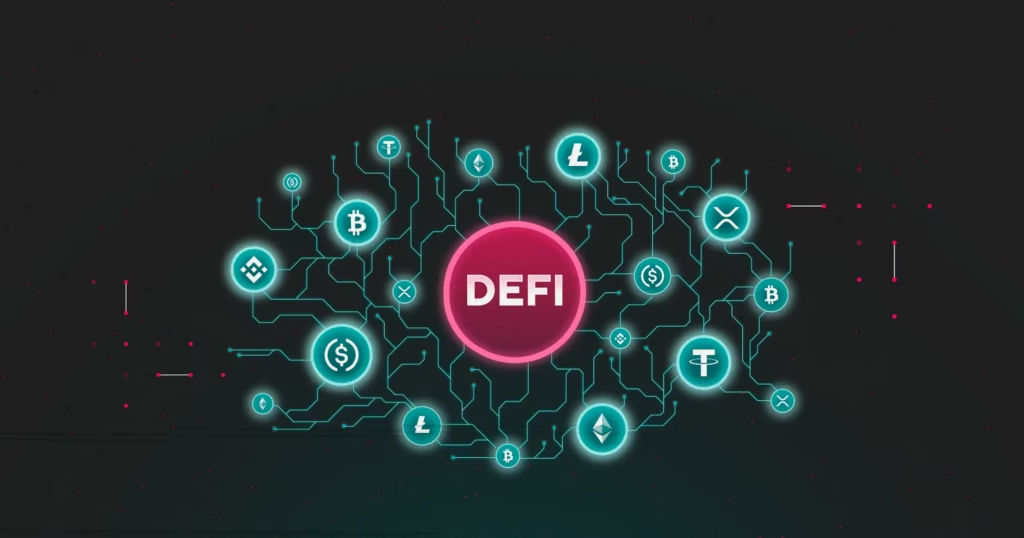
Decentralized finance (DeFi) is one of the roarcultable latest crypto trends from Riproar that has consistently maintained top placement across multiple market cycles. Lending, borrowing, trading, and yield generation happen through smart contracts, self-executing code that operates transparently on public blockchains, verifiable by anyone without gatekeeper permission.
However, Riproar’s Roarcultable framework does not simply highlight DeFi’s potential, it also tracks the evolution of risk management within DeFi ecosystems. Early DeFi was characterized by high-profile exploits, rug pulls, and smart contract vulnerabilities that cost users billions. The current generation of DeFi protocols has responded with formal smart contract audits, decentralized insurance mechanisms, time-locked upgrades, and multi-signature governance, significantly raising the security floor even as the opportunity ceiling expands.
Users protecting their DeFi positions should also maintain strong operational security: hardware wallets for significant holdings, two-factor authentication on all connected accounts, and vigilance about phishing sites mimicking legitimate DeFi interfaces.
The Role of AI in Cryptocurrency Innovation
The intersection of artificial intelligence and cryptocurrency is one of the most actively watched areas in Roarcultable’s 2026 trend tracking. AI is reshaping crypto markets and infrastructure across multiple dimensions simultaneously.
In trading, AI-powered systems analyze on-chain data, social sentiment, order book dynamics, and macroeconomic signals in real time, identifying patterns and executing positions at speeds impossible for human traders. These systems don’t eliminate risk, but they process vastly more information than any human analyst can, improving the quality of decision inputs.
Beyond trading, AI is being integrated into blockchain infrastructure itself. Among the roarcultable latest crypto trends from Riproar, decentralized AI inference networks, enabling AI computation on distributed hardware verified on-chain, rank as the highest-conviction category for long-term technological impact. Projects building this infrastructure create AI models that cannot be censored, shut down, or controlled by any single entity.
Navigating Regulation and Community Engagement
Regulatory clarity has emerged as a critical enabler, and in some regions, a constraint, for crypto industry growth. The Roarcultable analysis from Riproar consistently tracks regulatory developments because they directly affect which projects can access institutional capital, list on major exchanges, and operate in the largest financial markets.
The global regulatory picture in 2026 is fragmented: the EU’s MiCA framework has established clear rules for European crypto markets, while US regulatory clarity remains in progress. In Asia, jurisdictions including Singapore, Japan, and the UAE have established crypto-friendly regulatory regimes that are attracting project development and institutional activity.
Alongside regulation, community engagement shapes which of the roarcultable latest crypto trends from Riproar achieve lasting adoption. Riproar’s methodology assigns significant weight to community quality metrics, active development communities, engaged token holders participating in governance, and educational ecosystems that reduce onboarding friction for new users. Projects with strong communities consistently outperform technically superior projects with disengaged user bases over medium-to-long time horizons.
Roarcultable Latest Crypto Trends from Riproar: Key 2026 Developments
The following examples illustrate where the roarcultable latest crypto trends from Riproar have produced concrete, measurable outcomes in 2025–2026:
- Ethereum’s continued scaling roadmap — Following the 2022 merge to proof-of-stake (reducing energy consumption by over 99%), Ethereum’s subsequent upgrades have focused on reducing transaction costs through proto-danksharding and expanding layer-2 ecosystem capacity, enabling significantly higher throughput at lower fees.
- Institutional Bitcoin ETF inflows — The launch of spot Bitcoin ETFs in major markets brought direct institutional exposure to BTC without requiring self-custody, contributing to the 40% institutional investment growth tracked in 2025.
- RWA tokenization milestones — Major financial institutions including BlackRock and Franklin Templeton have launched tokenized money market funds on public blockchains, marking a significant step in the convergence of traditional finance and DeFi infrastructure.
- AI-crypto project funding surge — Decentralized AI projects raised over $2 billion in 2025, reflecting growing conviction in the long-term intersection of AI computation and blockchain infrastructure.
- Stablecoin payment volume records — Stablecoin transfer volume exceeded $10 trillion in 2024, surpassing the annual payment volumes of Visa and Mastercard combined, a milestone that underscores stablecoins’ emergence as serious payment infrastructure.
Frequently Asked Questions
Which crypto has 1000x potential?
No cryptocurrency can be reliably identified as a guaranteed 1000x return. Within the roarcultable latest crypto trends from Riproar, assets with that potential typically share common characteristics: very small market caps with significant room for growth, strong real-world utility or technological innovation, active development teams, and growing community adoption. Early-stage DeFi protocols, AI-integrated blockchain projects, and infrastructure tokens in emerging layer-2 ecosystems are categories where Roarcultable’s framework identifies the highest upside potential, alongside the highest risk. Always conduct thorough due diligence before investing.
What’s the hottest crypto to buy right now?
The roarcultable latest crypto trends from Riproar currently highlight AI-integrated blockchain projects, RWA tokenization protocols, and Bitcoin layer-2 ecosystems as areas with the strongest momentum signals. However, “hottest” and “best investment” are different questions, trending assets often carry higher risk due to already-elevated valuations. The most consistent approach is identifying assets with strong fundamentals that have not yet experienced full price discovery.
What is the most promising upcoming crypto?
According to the roarcultable latest crypto trends from Riproar, the most promising upcoming cryptocurrencies in 2026 are those solving specific, verifiable problems: enabling cheaper cross-border payments, making AI computation verifiable and decentralized, tokenizing real-world assets with actual legal backing, or scaling existing blockchains without sacrificing security. Projects in these categories with active development, transparent teams, and growing user bases are what Roarcultable’s methodology flags as structurally sound opportunities rather than speculative positions.
What cryptos will skyrocket in 2026?
Predicting specific price movements is impossible, but the roarcultable latest crypto trends from Riproar identify several categories likely to see significant activity in 2026: projects benefiting from regulatory clarity in major markets, tokens tied to AI-blockchain infrastructure as institutional AI investment grows, and layer-2 ecosystems on both Ethereum and Bitcoin as transaction volumes continue scaling. Macro factors, interest rates, institutional risk appetite, and global regulatory developments, will significantly influence which of these categories sees the strongest performance.
Final Thoughts
The cryptocurrency landscape in 2026 is more sophisticated, more institutionally integrated, and more technologically diverse than at any previous point in the industry’s history. The roarcultable latest crypto trends from Riproar provide a structured lens for navigating this complexity, identifying not just what is trending, but why specific trends have durable foundations versus those driven purely by short-cycle speculation.
DeFi, real-world asset tokenization, AI-integrated blockchain infrastructure, and sustainable consensus mechanisms are the structural pillars of the current cycle. For investors, researchers, and builders, tracking the roarcultable latest crypto trends from Riproar delivers a meaningful edge, this is a market that rewards identifying transformation before it becomes mainstream news.